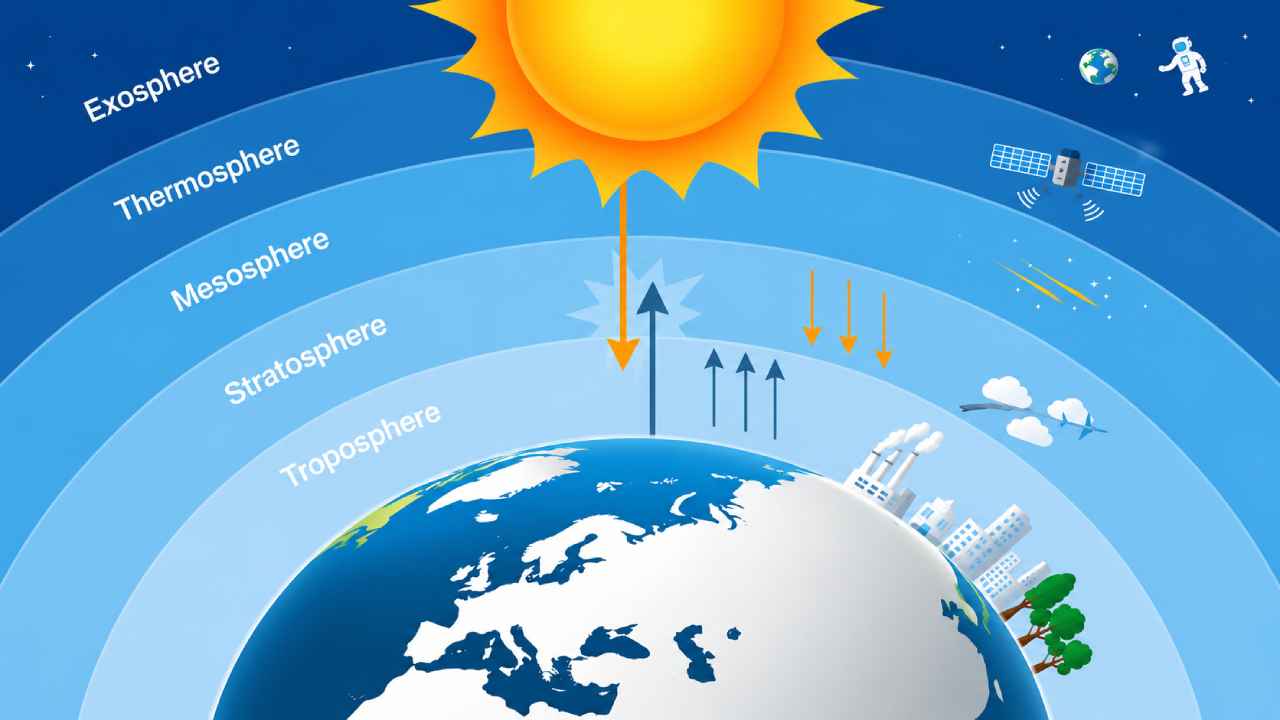
Round Rock Journal – Earth would be a very different planet without its Atmospheric Layers. These invisible layers surround the planet and create the conditions necessary for life to exist. They regulate temperature, block harmful radiation, and support weather systems that provide fresh water. Moreover, the atmosphere allows humans, animals, and plants to survive by maintaining a stable environment. Although many people think of the atmosphere as one continuous blanket of air, scientists divide it into several distinct layers based on temperature changes and physical characteristics. Therefore, understanding these Atmospheric Layers helps explain many natural phenomena, from rainfall and thunderstorms to auroras and satellite communication. As technology advances, researchers continue to discover new insights into how these layers interact and protect life on Earth.
Read Also: NIKI Returns Home at Prambanan Jazz After Rising to Global Stardom
The Atmosphere Is More Than Just Air
The atmosphere contains a mixture of gases, including nitrogen, oxygen, argon, carbon dioxide, and trace elements. Together, these gases form a protective shield around Earth. However, the atmosphere is not uniform from the ground to outer space. Instead, its temperature, density, and pressure change with altitude. Scientists classify these changes into five major Atmospheric Layers. Each layer has unique properties and performs specific functions that support life and maintain Earth’s balance. Furthermore, these layers constantly interact with sunlight, wind, water vapor, and natural energy. As a result, they create the dynamic environmental system that influences weather, climate, and even global communication networks.
Troposphere Supports Everyday Life
The troposphere is the lowest and most familiar of the Atmospheric Layers. It extends from Earth’s surface to an average altitude of about 8 to 18 kilometers, depending on location. Nearly all weather events occur within this layer because it contains most of the atmosphere’s water vapor. Consequently, clouds, rain, snow, thunderstorms, and strong winds develop here. In addition, approximately 75 percent of Earth’s atmospheric mass is concentrated in the troposphere. This layer also provides the oxygen required by humans and animals. Because temperature generally decreases with altitude, warm and cool air continuously circulate. Therefore, the troposphere plays a critical role in maintaining weather patterns and supporting every form of life.
Stratosphere Protects Earth from Harmful Radiation
Above the troposphere lies the stratosphere, which reaches an altitude of about 50 kilometers. This layer contains the famous ozone layer, one of Earth’s most valuable natural defenses. The ozone absorbs most of the Sun’s harmful ultraviolet radiation before it reaches the surface. Consequently, living organisms receive far less exposure to dangerous UV rays. Furthermore, the stratosphere experiences relatively stable air conditions compared with the turbulent troposphere. Because of this stability, many commercial aircraft fly near the lower stratosphere to avoid severe weather and reduce turbulence. Without this protective Atmospheric Layer, life on Earth would face much greater environmental risks.
Mesosphere Burns Incoming Meteors
The mesosphere extends from approximately 50 to 85 kilometers above Earth’s surface. Although this layer receives less attention than others, it performs an essential protective function. Most meteoroids entering Earth’s atmosphere burn up in the mesosphere because of intense friction with atmospheric particles. As a result, the bright streaks often called shooting stars rarely reach the ground. Interestingly, the mesosphere is also the coldest of the Atmospheric Layers, with temperatures dropping to around minus 90 degrees Celsius. Scientists continue to study this region because direct observation remains challenging. Nevertheless, its role in protecting Earth from small space debris is both significant and indispensable.
Read Also: Stop Comparing Yourself and Start Appreciating Your Own Journey
Thermosphere Enables Communication and Aurora Displays
The thermosphere begins around 85 kilometers above Earth and extends several hundred kilometers into space. Surprisingly, temperatures in this layer can exceed 1,500 degrees Celsius. However, the air is extremely thin, so heat transfer remains minimal. Within the thermosphere lies the ionosphere, where solar radiation creates electrically charged particles. These particles help reflect and transmit radio waves over long distances. Consequently, communication systems, navigation technologies, and some broadcasting services benefit from this natural phenomenon. In addition, spectacular auroras appear in this Atmospheric Layer when charged particles from the Sun collide with atmospheric gases. Therefore, the thermosphere contributes to both scientific research and everyday communication.
Exosphere Connects Earth with Outer Space
The exosphere is the outermost of Earth’s Atmospheric Layers. It gradually merges into outer space and contains extremely sparse particles. Because the air is so thin, gas molecules may travel long distances before colliding with one another. Many satellites orbit within or near this region while collecting valuable scientific and communication data. Furthermore, spacecraft pass through the exosphere during launches and reentry missions. Although this layer seems distant from daily life, it plays an important role in modern technology. Satellite navigation, weather forecasting, global positioning systems, and international communications all depend on equipment operating within this upper atmospheric environment.
Why Atmospheric Layers Matter for the Future
Understanding Atmospheric Layers has become increasingly important as climate change, environmental protection, and space exploration continue to evolve. Scientists use advanced satellites, weather balloons, and computer models to monitor atmospheric conditions with greater accuracy than ever before. Consequently, they can improve weather forecasts, study climate trends, and predict natural hazards more effectively. Moreover, researchers analyze atmospheric data to understand pollution, ozone recovery, and global temperature changes. As humanity expands its presence in space, knowledge of Earth’s atmosphere remains essential for protecting astronauts, designing spacecraft, and improving satellite operations. Ultimately, Atmospheric Layers are not simply scientific concepts. They are dynamic systems that sustain life, safeguard the planet, and support technological progress across the modern world.