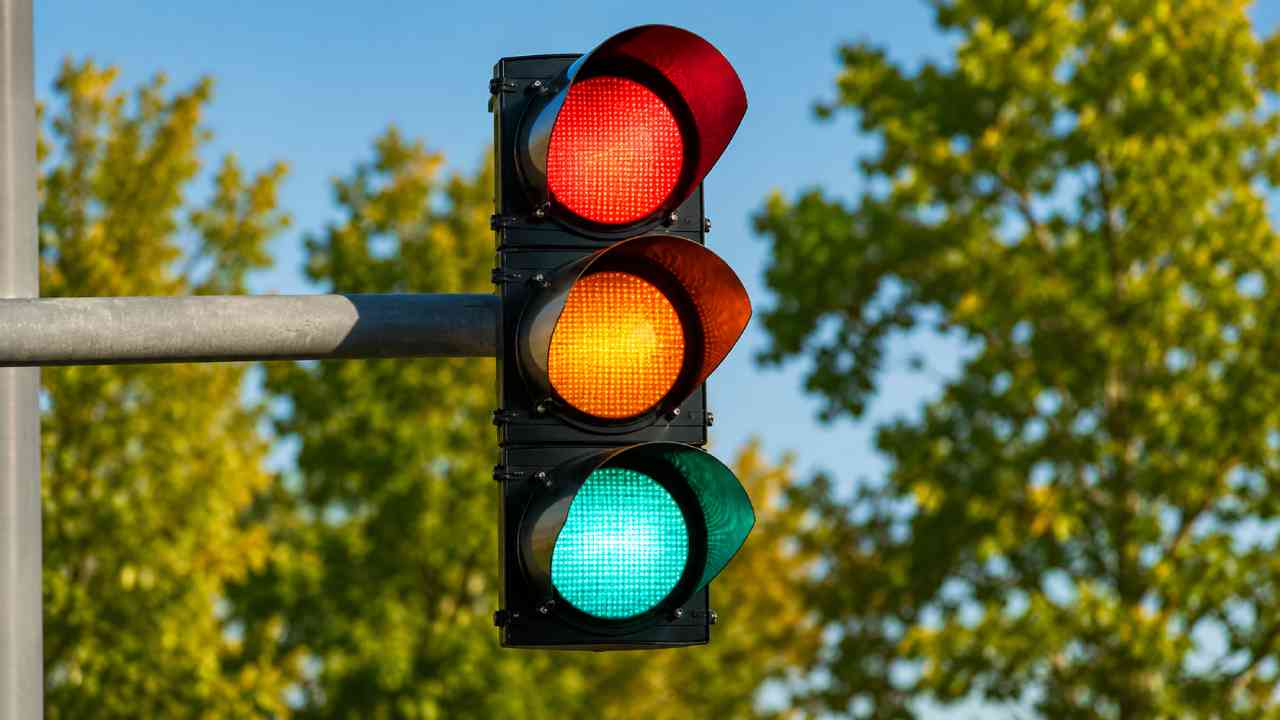
Round Rock Journal – Every day, millions of drivers respond to three familiar colors without giving them much thought. Red means stop, yellow signals a change, and green allows traffic to proceed when the way is safe. Yet why traffic lights use these particular colors has a surprisingly rich explanation. The answer combines railway history, human perception, engineering, and the need for universal road rules. Long before modern intersections became crowded with cars, transportation systems already needed clear visual signals. Railways helped establish several conventions that later influenced road traffic control. Over time, red, yellow, and green became a practical combination for communicating different instructions quickly. Their success also depends on consistency. Drivers do not need to read a message before reacting. Instead, a familiar color and its position provide immediate information. That simplicity is precisely why a century-old signaling concept still works in cities filled with increasingly sophisticated transportation technology.
Read Also: Mikel Arteta Backs Bruno Guimaraes to Bring a New Fighting Spirit to Arsenal
Traffic Signals Have Roots in Railway History
To understand why traffic lights developed their familiar color system, it helps to look beyond automobiles. Railways were already using visual signals to communicate important instructions before electric road signals became common. Train operators needed information that could be recognized from a distance and understood quickly. Colored signals became part of that system, although early railway conventions were not always identical to today’s road signals. As transportation networks expanded, greater standardization became essential. Red developed a strong association with danger and stopping, while other colors communicated different operating conditions. Road traffic engineers later adopted concepts from existing transportation signaling as motor vehicles became more common. This connection makes practical sense. Both trains and cars require clear instructions to prevent conflicting movements. Therefore, modern traffic lights were not invented in complete isolation. They evolved partly from earlier attempts to create a simple visual language for safely coordinating moving vehicles.
Why Red Became the Signal for Stop
Red has one of the strongest meanings in modern transportation: stop. Its use is supported by both historical convention and visual characteristics. Red light sits toward the long-wavelength end of the visible spectrum. However, wavelength alone does not fully explain its role in traffic control. Cultural familiarity, engineering standards, contrast, and decades of consistent use are equally important. Once red became strongly connected with danger and stopping in transportation systems, maintaining that convention offered a major safety advantage. Drivers could learn one rule and apply it repeatedly. Furthermore, red is visually distinct from green under normal viewing conditions, which helps separate two opposite instructions. Today, people encounter red stop signals in many settings beyond intersections, from warning indicators to transportation signage. Consequently, its meaning feels almost instinctive. In reality, that instant recognition reflects generations of standardization and repeated exposure rather than a single scientific reason.
Why Green Became the Color for Go
If red tells traffic to stop, another signal must clearly communicate permission to proceed. Green eventually became that signal in standardized traffic systems. The contrast between red and green creates two recognizable states with very different meanings. However, a green light does not mean that drivers can move without paying attention. It indicates that traffic may proceed according to the rules while the intersection is clear and safe. Pedestrians, turning vehicles, emergency traffic, and other hazards can still require caution. This distinction matters because traffic signals organize movement rather than remove responsibility from road users. Historically, green was also used within transportation signaling systems before modern road networks reached their present form. As standards became more consistent, the red-stop and green-go relationship became deeply established. Therefore, when asking why traffic lights use green, the answer involves both practical differentiation and the long-term value of maintaining a familiar transportation convention.
Why Yellow Is Essential Between Green and Red
Imagine an intersection where the signal changed instantly from green to red. A driver approaching the stop line could have very little time to respond safely. Yellow provides an important transition between those two states. It warns road users that the green phase is ending and a change is occurring. Consequently, drivers can respond according to their position, speed, road conditions, and local traffic rules. This transition reduces the uncertainty that could result from an abrupt signal change. Yellow also stands apart visually from both red and green, making it suitable for a separate instruction. Importantly, yellow should not simply be interpreted as an invitation to accelerate through an intersection. Its purpose is to communicate a changing traffic phase. Traffic engineers determine signal timing using factors such as roadway design and expected vehicle movement. Therefore, the yellow light is not decorative. It is a critical component that helps connect two opposing instructions more safely.
Why Traffic Lights Do Not Use Random Colors
Blue, purple, pink, or orange could theoretically be used to communicate instructions. However, safety systems benefit from consistency rather than endless choice. Drivers frequently travel between neighborhoods, cities, and countries. If every region developed an entirely different color code, intersections would become unnecessarily difficult to interpret. Standardized signals reduce that mental burden. A driver can approach an unfamiliar intersection and still recognize the basic instructions immediately. Moreover, existing conventions become more valuable as more people learn them. Changing established colors without a compelling safety reason could create confusion rather than improvement. This explains why traffic lights have retained a familiar visual identity even while the technology controlling them has advanced dramatically. The goal is not to make traffic signals visually creative. Instead, designers want them to be predictable, recognizable, and difficult to misunderstand. In road safety, familiarity is often a feature rather than a limitation.
Position Matters as Much as Color
Color is only one part of traffic signal design. The arrangement of individual lights also provides valuable information. In a common vertical configuration, red appears above yellow, while green sits below. Horizontal installations follow established arrangements according to applicable standards. This consistency creates another visual cue for road users. It is particularly useful because people do not all perceive color in exactly the same way. Someone with a color vision deficiency may rely partly on position, brightness, context, and the sequence of signals. Therefore, standardized placement adds redundancy to the system. Good safety design rarely depends on a single cue when additional cues can reduce ambiguity. The same principle appears in pedestrian signals, road signs, pavement markings, and directional arrows. Each element reinforces the message in a different way. As a result, understanding why traffic lights work so effectively requires looking beyond their colors and considering the complete visual system.
Traffic Lights Must Work for Different Drivers
Accessibility is an important consideration in transportation design. Red-green color vision deficiency can make certain color combinations harder to distinguish for some people. Fortunately, conventional traffic signals provide additional clues beyond hue alone. Position is one of the most obvious. Drivers also learn the normal sequence of signal phases and interpret each light within the surrounding road context. Brightness, signal shape, arrows, signs, and lane markings may provide further information depending on the intersection. Nevertheless, accessibility remains an ongoing engineering concern because road systems should communicate clearly to as many people as possible. Newer technologies can improve visibility through better optics and controlled light output. Meanwhile, consistent placement remains extremely valuable. This illustrates an important design lesson: successful public infrastructure should not assume that every user experiences visual information identically. Instead, multiple cues can work together to make essential instructions clearer and safer.
Read Also: Keep Working Even When Nobody Is Watching Your Progress
Modern Traffic Signals Are Smarter Than They Look
The familiar red, yellow, and green display may appear simple, but the technology behind an intersection can be far more sophisticated. Some traffic systems use vehicle detectors, cameras, coordinated controllers, or other sensors to manage signal phases. These technologies can help transportation agencies respond to changing traffic conditions. In coordinated corridors, multiple intersections may also work together to improve traffic flow. Meanwhile, pedestrian crossings can have separate timing requirements and dedicated signals. Despite these advances, the basic color language remains recognizable. This is a good example of technology improving the system without forcing users to learn an entirely new interface. Drivers still see familiar instructions, while increasingly capable equipment operates behind the scenes. Therefore, why traffic lights continue using three traditional colors becomes easier to understand. A proven human-facing system can remain stable even when the technology controlling it changes significantly.
How Traffic Lights Became a Shared Road Language
One of the greatest strengths of traffic signals is how quickly people can understand them. A traveler may not speak the local language, yet a red traffic signal still communicates a familiar instruction. International road systems are not identical, and local laws always matter. Even so, the basic red-yellow-green convention is widely recognizable. This shared visual vocabulary reduces dependence on written instructions at one of the most time-sensitive places on the road: an intersection. Moreover, repetition strengthens recognition. People encounter the same sequence throughout years of walking, cycling, driving, and using public transportation. Eventually, responding to the signals requires very little conscious interpretation. From a design perspective, that efficiency is remarkable. Three colors can coordinate complicated movements involving vehicles and pedestrians within seconds. The system succeeds because its message is simple, repeated, and standardized. Sometimes, the most effective technology is the one people barely notice themselves using.
Why Three Familiar Colors Still Make Sense Today
Transportation has changed enormously since early signaling systems appeared. Cars now contain cameras, navigation systems, driver-assistance features, and increasingly sophisticated electronics. Cities can collect traffic data and adjust transportation networks using tools that early engineers could never have imagined. Yet the fundamental traffic signal remains remarkably familiar. Red, yellow, and green continue to work because drivers already understand their roles, while standardized positioning adds another layer of recognition. Replacing this system simply because newer technology exists would offer little benefit if the alternative created additional confusion. That is ultimately the clearest answer to why traffic lights still use these colors. They represent a combination of historical development, practical engineering, human recognition, and global familiarity. Every time an intersection changes from green to yellow and finally red, a surprisingly old transportation language continues doing an essential modern job.