Round Rock Journal – Anyone who has accidentally swallowed seawater knows how strong its salty taste can be. However, that familiar taste tells a much larger story about our planet. Ocean water contains dissolved substances called ions. Sodium and chloride are among the most abundant, and together they create the familiar salty character of seawater. Yet the salt did not suddenly appear in the ocean. Instead, natural processes have carried dissolved minerals into the sea over extremely long periods. Rain, rivers, rocks, and geological activity all play a role. Therefore, understanding why ocean water is salty requires looking far beyond the beach. The answer begins on land, continues through rivers, and eventually reaches the ocean. This continuous movement of water and dissolved material helps explain why seawater tastes very different from the rain falling from the sky.
Read Also: Veda Ega Battles at the Front Before Finishing Sixth in Moto3 Mandalika
Rain and Rocks Help Explain Why Ocean Water Is Salty
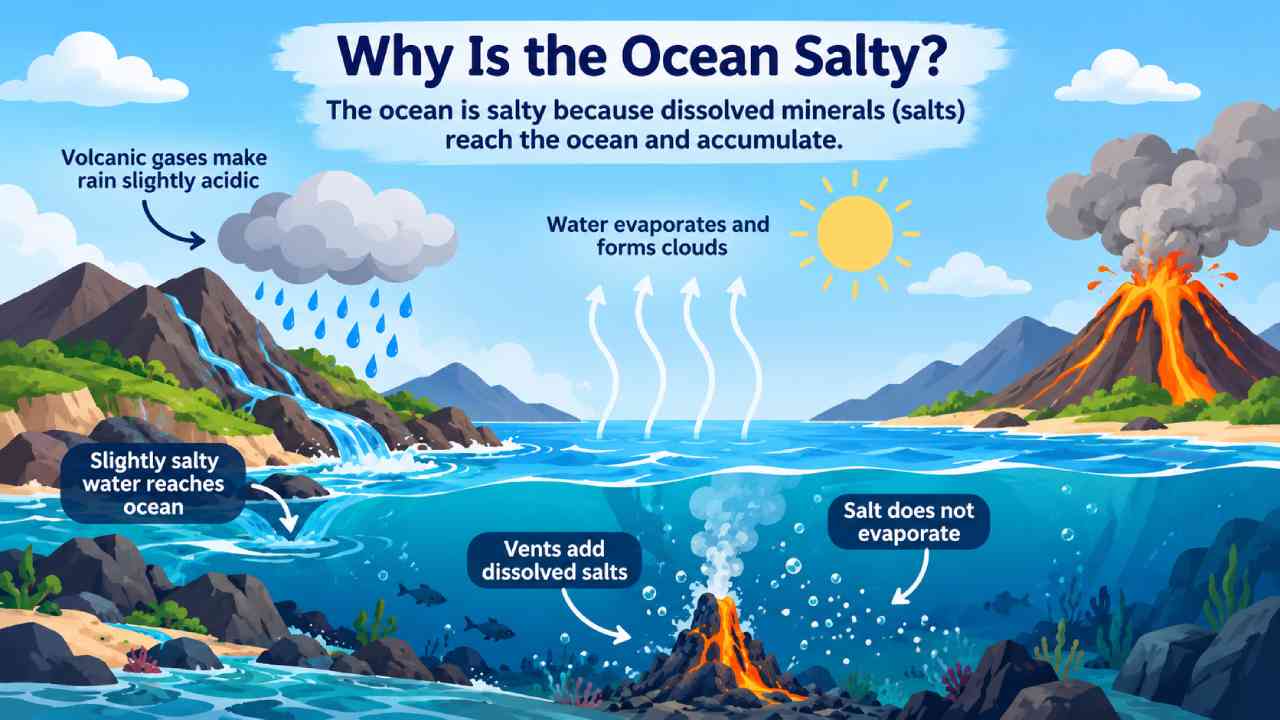
The journey begins when rain reaches the ground. Rainwater interacts with gases in the atmosphere and soil, making it capable of contributing to rock weathering. As water moves across and through the ground, it helps dissolve certain minerals. Those dissolved materials can enter streams and rivers. Eventually, rivers transport many dissolved ions toward the ocean. This process may seem insignificant during a single rainstorm. However, it becomes powerful when considered across vast periods of geological time. Rivers continually deliver dissolved substances from the continents to the sea. Meanwhile, other geological processes also influence seawater chemistry. As a result, ocean salinity reflects a complex balance between materials entering and leaving the marine environment. Therefore, the salty ocean we recognize today is connected to countless interactions among rain, rocks, rivers, sediments, and the Earth’s changing surface.
Rivers Carry Dissolved Minerals Toward the Sea
A river may taste fresh, yet it still contains small amounts of dissolved substances. The difference is concentration. River water generally contains far less dissolved salt than seawater. As rivers travel toward the coast, they carry ions released through weathering and other natural processes. Once the water reaches the ocean, those materials enter a much larger marine system. However, this does not mean every dissolved substance remains there forever. Various chemical, biological, and geological processes remove certain ions from seawater. For example, some materials become incorporated into minerals or sediments. Marine organisms can also use particular dissolved elements. Consequently, ocean chemistry represents an ongoing balance rather than simple salt accumulation. This distinction is important when asking why ocean water is salty. The ocean receives dissolved material continuously, but it also loses material through natural processes. That balance helps maintain the distinctive chemistry of seawater.
Evaporation Separates Water From Most Dissolved Salts
The difference between seawater and rain becomes clearer when evaporation begins. Sunlight warms the ocean surface and gives water molecules enough energy to enter the atmosphere as vapor. However, dissolved salts do not evaporate with water under normal environmental conditions. Most of them remain behind in the ocean. A simple kitchen example helps explain the idea. Imagine leaving saltwater in a shallow container for several days. As the water slowly evaporates, the salt does not disappear into the air with it. Instead, the dissolved material remains in the container and becomes more concentrated as water leaves. A similar principle operates across the ocean on an enormous scale. Therefore, evaporation acts as a natural separation process. Water molecules enter the atmosphere, while most dissolved salts stay in the sea. This basic process provides the key reason rainwater does not taste like ocean water.
Clouds Form From Water Vapor Rather Than Ocean Salt
After evaporation, water vapor rises into the atmosphere. As the air cools, that vapor condenses into tiny liquid droplets or ice crystals. Large numbers of these particles eventually form visible clouds. Since most dissolved sea salts stayed behind during evaporation, cloud water is not simply seawater floating above us. This difference explains an important part of the water cycle. Water can move from the ocean to the atmosphere without carrying most of the ocean’s dissolved salt with it. However, the atmosphere itself is not perfectly clean. Sea spray can place tiny salt particles into the air. Dust, gases, smoke, and other aerosols can also interact with cloud droplets. Therefore, atmospheric water may contain small amounts of different substances. Even so, its composition remains very different from seawater. Consequently, clouds can produce rain that lacks the intense salinity associated with the ocean below.
Why Rainwater Does Not Taste Like Seawater
Once cloud droplets become large enough, gravity brings them back toward the surface as precipitation. At this stage, the water has already passed through evaporation and condensation. Most sea salt was left behind before the water entered the atmosphere. Therefore, rainwater does not contain the high concentration of dissolved salts found in seawater. Still, rain should not be described as perfectly pure water. As raindrops move through the atmosphere, they can collect gases and airborne particles. Local conditions can affect their chemistry as well. For instance, air pollution, dust, volcanic emissions, and sea spray may influence what rain contains. Nevertheless, these substances do not normally make rainfall comparable to seawater in salinity. In simple terms, the water cycle naturally separates water from most dissolved ocean salts. That process explains why rain falling near a beach does not normally taste like the sea beside it.
Ocean Salinity Is Maintained by a Dynamic Natural Balance
It might seem logical to assume that the ocean should become saltier every year. After all, rivers continue carrying dissolved material toward the sea. However, ocean chemistry is more complicated than a container that simply collects salt. Natural processes continuously remove dissolved substances from seawater. Some ions become part of minerals that settle into marine sediments. Others participate in chemical reactions near the seafloor. In addition, marine organisms use certain dissolved elements to build shells, skeletons, and other biological structures. Geological processes can later bury or recycle these materials. Therefore, ocean salinity reflects interactions between inputs and outputs over long timescales. This dynamic balance is one reason scientists study seawater chemistry to understand Earth’s systems. Rather than remaining chemically unchanged, the ocean constantly interacts with the atmosphere, continents, living organisms, sediments, and the planet’s crust. Its salty character is the visible result of an enormous natural system.
Read Also: How to Face Uncertainty Without Rushing Into a Decision
The Seafloor Also Influences Ocean Water Chemistry
Rivers are important, but they are not the only influence on ocean chemistry. Deep beneath the waves, seawater interacts with rocks in the oceanic crust. Hydrothermal systems provide a striking example. Seawater can move through cracks in the seafloor, become heated, and react with surrounding rocks. When this altered water returns to the ocean, its chemical composition has changed. These reactions can add some dissolved substances while removing others. Therefore, the seafloor acts as another important part of the ocean’s chemical cycle. Volcanic and tectonic activity can also influence marine environments over geological timescales. This perspective makes the question of why ocean water is salty more interesting. The answer does not involve only rivers carrying minerals from land. Instead, it involves interactions across the entire Earth system. Continents, oceans, atmosphere, and seafloor processes all contribute to the chemistry we observe today.
The Water Cycle Connects Rain, Rivers, and Oceans
The entire process becomes easier to understand when viewed as one continuous cycle. First, sunlight provides energy that drives evaporation from oceans and other water surfaces. Next, water vapor enters the atmosphere and eventually condenses. Clouds form, and precipitation returns water to Earth’s surface. Some rainfall flows directly into rivers, while some enters soil and groundwater. Along the way, water interacts with rocks, minerals, gases, and living systems. Rivers then carry water and dissolved substances toward lakes and oceans. Eventually, evaporation begins the atmospheric journey again. However, most dissolved ocean salts remain behind when seawater evaporates. Consequently, the same water cycle can connect salty oceans with relatively fresh rainfall. This cycle also demonstrates how closely Earth’s systems interact. A raindrop falling far inland may eventually travel through soil, enter a river, reach the sea, evaporate, and return to the atmosphere once again.
A Simple Question Reveals a Remarkable Earth System
Asking why ocean water is salty but rainwater is not may sound like a simple classroom question. Yet the explanation connects chemistry, geology, weather, and the global water cycle. Ocean water contains dissolved ions supplied and transformed through many natural processes. Meanwhile, evaporation allows water molecules to leave the ocean while most dissolved salts remain behind. Condensation then turns atmospheric water vapor into cloud droplets, which can eventually fall as rain. Therefore, rain does not inherit the ocean’s high salinity simply because much of its water originally evaporated from the sea. More importantly, the process shows how efficiently Earth recycles water. Water continuously moves between oceans, atmosphere, land, rivers, and underground systems. The next time rain falls near the coast, it offers a small demonstration of a planetary process that has operated for an extraordinarily long time.