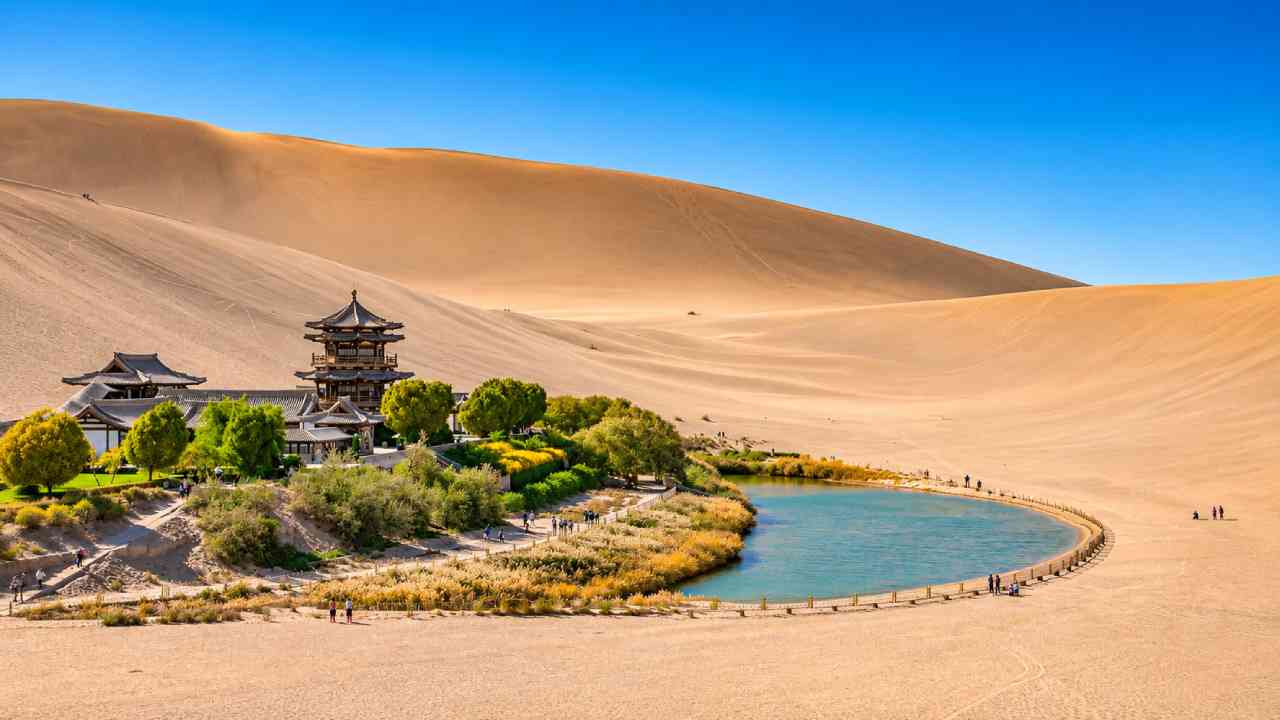
Round Rock Journal – Mingsha Shan reveals one of China’s most fascinating natural phenomena through its remarkable singing sand dunes. Located near Dunhuang in Gansu Province, this landscape combines golden hills with unusual acoustic activity. Unlike ordinary desert environments, its shifting sands can produce distinctive sounds under suitable conditions. These sounds may resemble deep humming or distant musical vibrations. Consequently, the mountain has attracted curious travelers and scientific interest for generations. Its Chinese name refers to the remarkable ability of sand to produce sound. Moreover, the surrounding landscape creates a striking contrast between dry dunes and a natural oasis. Imagine standing among enormous sandy hills while hearing a mysterious vibration beneath your feet. Such an experience challenges the familiar perception of deserts as silent environments. Beyond its scenic beauty, this destination offers valuable insights into geology, physics, and the remarkable behavior of natural materials.
Discovering the Remarkable Geography of Mingsha Shan
The geographical setting plays an important role in shaping this extraordinary desert landscape. The scenic area lies approximately five kilometers south of Dunhuang in northwestern China. jiuquan.gogansu.com Its surroundings feature expansive dunes, dry terrain, and dramatic sandy ridges. Over time, wind transports loose sediment and gradually builds these impressive formations. Furthermore, changing wind directions continuously influence the appearance of their surfaces. Some slopes display delicate ripple patterns, while others develop smooth and sweeping curves. These formations create different visual perspectives throughout the day. For instance, morning sunlight highlights fine textures across the sandy landscape. Meanwhile, evening shadows reveal the dramatic contours of towering dunes. This changing scenery demonstrates how natural forces continuously reshape desert environments. Rather than remaining completely still, the landscape undergoes gradual transformation. Therefore, understanding its geography provides an essential foundation for exploring the mysterious sounds within its dunes.
Understanding the Science Behind Singing Sand
The mysterious sounds of Mingsha Shan originate from physical processes rather than supernatural forces. When dry sand moves downhill, countless grains interact with neighboring particles. These interactions generate small vibrations throughout the moving material. However, ordinary grain movement does not always produce audible sounds. Under particular conditions, collective vibrations can create a recognizable acoustic effect. Scientists have investigated this phenomenon through field observations and controlled laboratory experiments. Research published in Physical Review Letters connects sound frequency with the relative movement of sand grains. APS Journals Meanwhile, researchers at Caltech have explored how internal sand layers influence sound transmission. CaltechAUTHORS These findings illustrate the complexity of acoustic behavior within granular materials. Although researchers have proposed different explanations, collective grain movement remains central to the phenomenon. Consequently, singing dunes provide a compelling example of how simple physical interactions can generate surprisingly complex natural events.
Read Also: Malaysian Drug Syndicate Exposed Over Alleged Military Aircraft Smuggling Route to Indonesia
Why Certain Sand Grains Produce Extraordinary Sounds
Not every desert possesses the physical conditions necessary to create singing sand. Grain characteristics, surface properties, and moisture levels can influence acoustic behavior. For example, dry grains generally move more freely than damp particles. Moisture can introduce adhesion between grains and disrupt their collective movement. Similarly, grain size and consistency may affect how vibrations develop during a sand avalanche. Researchers have also examined the influence of internal dune structures on acoustic frequencies. Therefore, the phenomenon involves more than simple friction between individual particles. The arrangement and movement of countless grains contribute to the resulting sound. In comparison, ordinary beach sand may produce brief squeaking noises rather than deep desert vibrations. ScienceDirect This distinction highlights the diversity of natural acoustic phenomena. More importantly, it demonstrates how subtle differences in material properties can produce remarkably different sensory experiences.
The Fascinating Relationship Between Wind and Desert Acoustics
Wind represents one of the most influential forces shaping desert environments. It transports loose particles, creates surface ripples, and gradually changes dune formations. In addition, accumulated sand can become unstable along steep slopes. Gravity then causes some of these particles to move downhill. Under favorable conditions, this movement may generate the vibrations associated with singing dunes. However, wind alone does not explain every acoustic event. Natural sand avalanches can also initiate the process without strong winds. Similarly, external disturbances may trigger grain movement on suitable slopes. The resulting sound depends on several interacting physical conditions. California Institute of Technology As a result, visitors cannot expect the mountain to produce identical sounds during every encounter. Its acoustic behavior remains closely connected to environmental changes. This unpredictable relationship makes the phenomenon particularly fascinating. It also illustrates how deserts function as dynamic systems rather than motionless landscapes.
Crescent Moon Spring Creates a Remarkable Desert Contrast
Beyond its unusual sounds, Mingsha Shan features another extraordinary natural attraction known as Crescent Moon Spring. This distinctive oasis lies among the surrounding sandy hills near Dunhuang. Its curved appearance resembles a crescent moon, creating an unforgettable visual identity. Meanwhile, surrounding vegetation introduces a refreshing contrast against the golden desert. The presence of water within such an arid landscape raises interesting environmental questions. Groundwater availability plays an important role in supporting desert oases. However, changing water resources can threaten their long-term stability. Consequently, protecting these environments requires careful management and scientific understanding. Crescent Moon Spring also demonstrates how water and dry landscapes can exist within remarkably close surroundings. From a geographical perspective, this contrast highlights the importance of local environmental conditions. Furthermore, it offers a valuable opportunity to explore the relationship between desert ecosystems, groundwater, and landscape conservation.
Historical Connections With the Ancient Silk Road
The cultural significance of this landscape extends beyond its geological and acoustic characteristics. Nearby Dunhuang served as an important center along the ancient Silk Road. Merchants, travelers, and religious communities passed through this region during different historical periods. Consequently, the surrounding desert became part of a broader network of cultural exchange. Its dramatic landscapes also influenced local traditions and historical narratives. Before modern scientific explanations, unusual natural sounds often inspired imaginative interpretations. Such stories reflected human curiosity about unfamiliar environments. However, scientific investigation now offers physical explanations for many mysterious natural events. This contrast between traditional interpretation and modern knowledge adds depth to the region’s identity. Moreover, the historical setting encourages visitors to appreciate the landscape from multiple perspectives. Its significance involves geography, cultural heritage, and scientific discovery. Together, these elements create a richer understanding of the relationship between human civilization and desert environments.
Comparing Mingsha Shan With Other Singing Deserts
China’s famous singing sand mountain belongs to a wider collection of remarkable acoustic landscapes. A scientific review documented booming dunes at no fewer than 40 locations worldwide. Annual Reviews Similar phenomena occur in desert regions across North America, Africa, and Asia. However, each location may display different acoustic characteristics. Some dunes generate deep vibrations, while others produce shorter or less intense sounds. These differences encourage researchers to investigate local environmental and geological conditions. Furthermore, laboratory studies have recorded sound levels reaching 110 decibels in certain singing sand phenomena. PubMed This measurement does not necessarily represent the sound intensity at Mingsha Shan. Instead, it illustrates the potential acoustic power of moving granular materials. Comparing different locations helps scientists identify common physical patterns. Consequently, these extraordinary deserts contribute to a broader understanding of acoustics, sediment movement, and natural vibration.
Preserving the Natural Beauty of an Extraordinary Landscape
The distinctive character of Mingsha Shan highlights the importance of responsible environmental preservation. Desert landscapes may appear durable, yet their ecological systems can remain sensitive to human activity. Excessive waste, uncontrolled development, and pressure on water resources can introduce environmental challenges. Therefore, responsible tourism should respect designated pathways and local conservation measures. Protecting nearby water resources also supports the stability of the surrounding oasis. Furthermore, educational activities can help visitors understand the scientific importance of singing dunes. Rather than treating the phenomenon as simple entertainment, people can appreciate its geological and acoustic significance. Such awareness encourages a more meaningful relationship with natural environments. Meanwhile, continued research may improve knowledge of granular movement and desert sound production. Maintaining the landscape’s natural character allows future generations to explore its remarkable beauty. It also preserves an unusual setting where physics, geography, history, and environmental education come together.