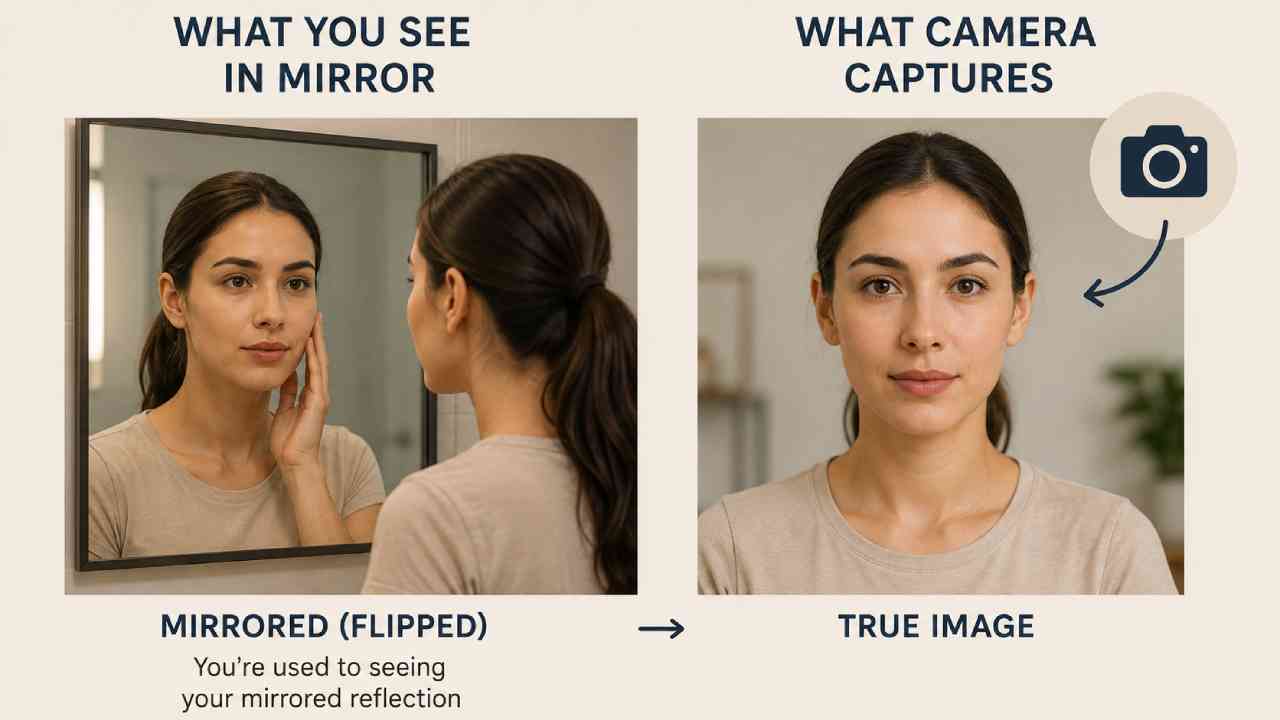
Round Rock Journal – You check the mirror before leaving home and feel completely familiar with the person looking back. Minutes later, someone takes a photo, and suddenly something seems different. Perhaps your smile looks uneven, your nose appears more noticeable, or your hairstyle seems to fall toward the wrong side. This experience is surprisingly common. When Your Face Looks different in a photograph, it does not mean your appearance suddenly changed. Instead, mirrors and cameras present facial features through different perspectives. Moreover, familiarity, lighting, lens distance, facial asymmetry, and image processing can influence what you notice. Understanding these factors explains why a reflection can feel natural while an ordinary photograph sometimes seems unfamiliar.
Read Also: Rio de Janeiro to Host MotoGP 2027 Season Launch in Spectacular Brazilian Return
Mirrors Show a Reversed Version of Your Face
A mirror does something simple but important: it presents a reflected view. Therefore, the facial arrangement you see every morning differs in orientation from the version other people usually observe. Imagine that your hair naturally falls toward one side or one eyebrow sits slightly higher. In a mirror, those characteristics appear on the opposite side of the reflected image. After thousands of everyday glances, this version becomes deeply familiar. Consequently, seeing a photograph with a different orientation can create an immediate sense that something is unusual. Nothing has actually moved on your face. Rather, familiar details have switched positions from the arrangement your brain expects. This small difference can be surprisingly noticeable because human perception is highly sensitive to faces.
Familiarity Changes What Your Brain Prefers
Repeated exposure plays an important role in visual preference. Since most people see themselves in mirrors regularly, the reflected version becomes the image they know best. A photograph may therefore seem strange simply because it presents familiar facial details differently. This effect becomes particularly noticeable when the face has natural asymmetry. However, unfamiliarity should not automatically be interpreted as unattractiveness. It simply means the visual information differs from what your brain commonly receives. Other people have a different reference point because they normally see your non-mirrored appearance. Therefore, a photograph that looks unusual to you may appear completely ordinary to friends or family. This difference between familiarity and appearance is one reason judging yourself from a single photograph can be misleading.
Natural Facial Asymmetry Becomes More Noticeable
Human faces are not perfectly symmetrical. One eyebrow may curve differently, one cheek may appear slightly fuller, or one side of the smile may rise higher. These subtle variations give faces individuality. However, reversing their positions can make them suddenly stand out. When Your Face Looks unfamiliar in a photograph, natural asymmetry may be one of the first things you notice. Importantly, these differences are usually far less striking to other people. They see your facial movements continuously rather than examining a frozen image. In everyday conversation, expressions, eye movement, posture, and changing angles all contribute to how a face is perceived. A photograph removes much of that context. As a result, tiny details can seem disproportionately important when you study the image for several seconds.
Camera Distance Can Change Facial Proportions
Camera distance can significantly influence facial perspective. A smartphone held very close to the face creates a different relationship between nearby and distant features. The nose, for example, sits closer to the lens than the ears. At short shooting distances, this difference can make central facial features appear proportionally larger. Moving the camera farther away generally reduces this perspective effect. That is why a portrait taken from a comfortable distance may feel more natural than a close selfie. The important factor is not simply whether a camera uses a wide or narrow lens. Shooting distance strongly shapes perspective. Photographers often adjust both distance and focal length to create flattering portraits while maintaining the desired framing. Therefore, comparing a close selfie directly with a mirror reflection is rarely a fair comparison.
Lighting Can Transform How Your Features Appear
Light can dramatically change facial appearance without changing the face itself. Soft light from the front tends to reduce strong shadows. Meanwhile, overhead lighting may create deeper shadows beneath the eyes, nose, and chin. Side lighting can emphasize facial structure and texture even more. Consequently, Your Face Looks different depending on where you stand relative to a light source. Color temperature also affects the overall impression. Warm indoor lighting produces a different atmosphere from cool daylight. Additionally, smartphone cameras may automatically adjust exposure and contrast after capturing an image. These changes can subtly influence skin tone and shadow detail. For a more natural portrait, indirect window light is often a useful starting point because it tends to illuminate the face evenly without producing extremely harsh shadows.
A Photograph Freezes One Tiny Moment
Looking into a mirror is an active experience. You move your head, change your expression, adjust your posture, and naturally settle into angles that feel comfortable. A photograph works differently because it captures one brief instant. Perhaps your eyes were beginning to blink. Maybe your mouth was transitioning between expressions, or your head moved slightly as the shutter activated. That fraction of a second can then remain frozen indefinitely. Furthermore, we tend to inspect photographs much longer than people normally examine our faces during everyday interactions. This encourages us to notice details that would disappear almost instantly in real life. Video can sometimes feel more recognizable for this reason. It restores movement and expression, providing additional visual context that a single still image cannot capture.
Smartphone Processing Can Alter the Final Image
Modern smartphone photography involves more than simply recording light. Many devices automatically combine image data, adjust exposure, sharpen details, reduce noise, and balance bright and dark areas. Front-facing cameras and individual apps may also handle image orientation differently. Some display a mirrored preview but save the final picture in another orientation. Therefore, the image visible before pressing the shutter may not perfectly match the saved photograph. Portrait modes can introduce additional processing by separating the subject from the background and simulating shallow depth of field. These tools can produce excellent results, yet they also demonstrate why photographs are interpretations rather than perfect copies of visual reality. Checking camera and application settings can help explain unexpected differences between the preview and final image.
Read Also: One Year Can Change Your Life Without You Realizing It
Other People Do Not See You Like a Still Photo
It is tempting to ask whether the mirror or camera shows the “real” face. However, this question oversimplifies human vision. People encounter you as a moving, three-dimensional person. They see changing expressions, gestures, posture, eye contact, and many different angles. Distance also changes constantly during normal interaction. Therefore, neither one mirror reflection nor one photograph fully represents how you appear to someone else. A camera compresses a three-dimensional scene into a two-dimensional image. Meanwhile, a mirror provides a live but reversed reflection. Both contain useful visual information, but each has limitations. In my view, understanding this distinction is especially helpful because it prevents one awkward photograph from becoming an unrealistic standard for judging appearance.
Why Some Photos Feel More Natural Than Others
You may notice that certain photographs immediately feel recognizable while others seem completely unfamiliar. Several factors usually work together. Comfortable shooting distance can create natural perspective. Balanced lighting can preserve facial detail without exaggerated shadows. A relaxed expression can also resemble how others normally see you. In contrast, an extremely close camera, unusual angle, harsh overhead light, and poorly timed expression can combine to produce a surprising result. Context matters as well. Candid photographs sometimes feel more authentic because attention is directed toward an activity rather than the camera. However, candid images can also capture transitional expressions. Therefore, no single photographic style guarantees a perfect representation. Looking across several images usually provides a more balanced impression than focusing intensely on one frame.
Understanding the Difference Changes How You See Photos
Once you understand why Your Face Looks different across mirrors and photographs, the contrast becomes less mysterious. Mirrors reverse orientation, while camera distance influences perspective. Lighting reshapes shadows, natural asymmetry becomes noticeable when reversed, and photographs freeze expressions that normally last only moments. Meanwhile, smartphone processing may introduce additional visual changes. None of these factors means one version is automatically false and another is completely accurate. Instead, each provides a different representation of the same three-dimensional face. This is also why portraits can change dramatically without heavy editing. Moving the camera farther away or turning toward softer light may be enough to create a noticeably different result. Ultimately, human appearance is dynamic, while photographs capture only isolated moments within that much larger visual experience.