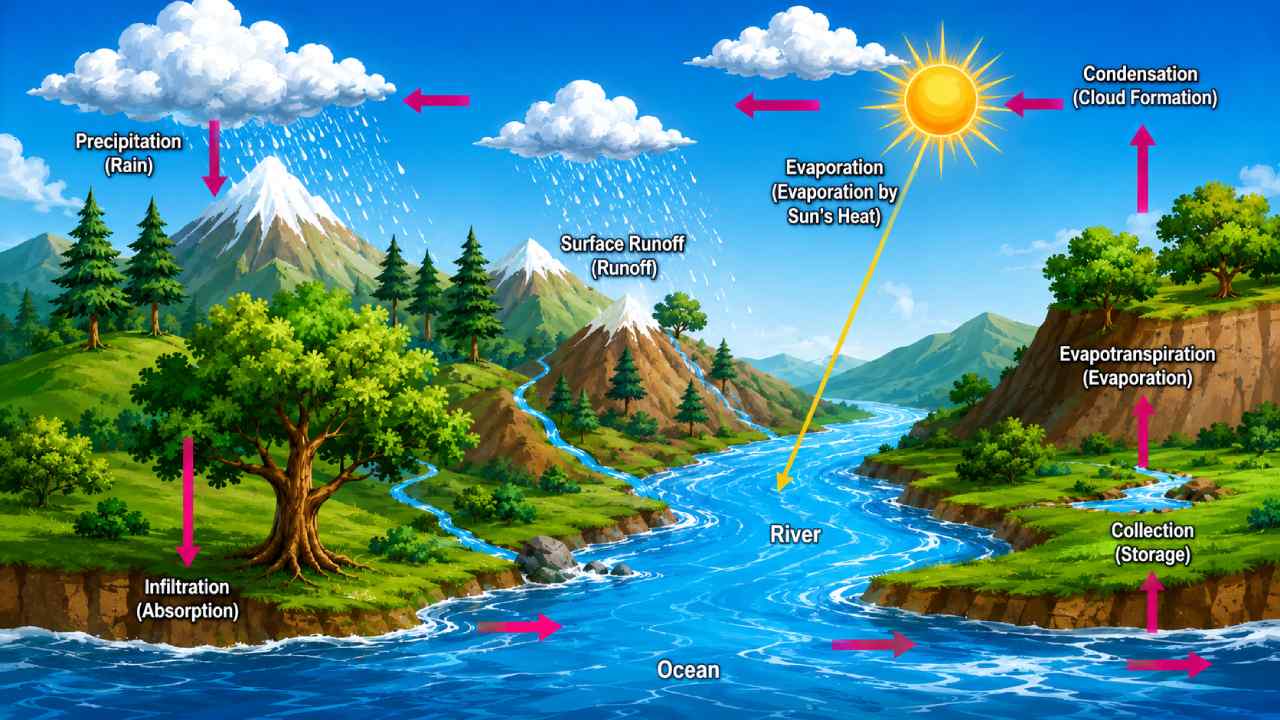
Round Rock Journal – The Water Cycle is one of Earth’s most important natural systems because it continuously moves water between the atmosphere, land, and oceans. Without this ongoing process, fresh water would not be distributed efficiently across different regions. Every living organism depends on water, making the water cycle essential for ecosystems, agriculture, and human communities. Although many people only associate the cycle with rainfall, it actually includes several interconnected processes that occur every day. As a result, rivers continue flowing, groundwater is replenished, and plants receive the moisture they need to grow. Understanding this remarkable cycle helps people appreciate how nature carefully maintains one of the planet’s most valuable resources.
Read Also: Cristiano Ronaldo Faces His Toughest World Cup Test After Playing Every Minute for Portugal
What Is the Water Cycle?
The Water Cycle, also known as the hydrologic cycle, describes the continuous movement of water throughout Earth’s environment. Unlike many natural resources, water is constantly recycled rather than permanently consumed. Instead, it changes location and physical state while following a repeating pattern driven primarily by solar energy and gravity. Water may exist as liquid, vapor, or ice depending on temperature and atmospheric conditions. Consequently, the same water molecules can travel through oceans, clouds, rivers, glaciers, soil, plants, animals, and the atmosphere over many years. This continuous circulation allows water to remain available for life despite changing environmental conditions.
Evaporation Begins the Journey
The first major stage of the Water Cycle is evaporation. During this process, sunlight heats water found in oceans, lakes, rivers, reservoirs, and moist soil. As temperatures increase, liquid water gradually transforms into water vapor and rises into the atmosphere. Oceans contribute the largest share of global evaporation because they cover approximately 71 percent of Earth’s surface. However, smaller water bodies also play meaningful roles within local environments. Even puddles, wet roads, and freshly washed clothes demonstrate evaporation during everyday life. Therefore, this familiar process represents the beginning of an extraordinary global system that never truly stops.
Plants Also Contribute Through Transpiration
In addition to evaporation, plants release water vapor into the atmosphere through a process known as transpiration. After roots absorb water from the soil, the water moves through stems and eventually exits tiny openings called stomata located on leaves. Although each plant releases only a small amount, forests and large vegetation areas collectively contribute significant moisture to the atmosphere. Scientists often combine evaporation and transpiration into one process called evapotranspiration because both move water from Earth’s surface into the air. Consequently, healthy forests play a critical role in maintaining regional rainfall patterns and supporting climate stability.
Condensation Creates Clouds
As water vapor rises higher into the atmosphere, temperatures gradually decrease. Eventually, the vapor cools enough to transform back into tiny liquid droplets through condensation. These microscopic droplets gather around airborne particles such as dust, pollen, or sea salt, forming visible clouds. Under colder conditions, some water vapor freezes into ice crystals instead. As condensation continues, clouds become denser and heavier. Although clouds appear light from the ground, they actually contain enormous amounts of water suspended within the atmosphere. This stage represents a crucial transition before water returns to Earth’s surface through precipitation.
Precipitation Returns Water to Earth
Once water droplets or ice crystals become sufficiently large, gravity causes them to fall back to Earth’s surface as precipitation. Depending on atmospheric temperatures, precipitation may occur as rain, snow, sleet, or hail. Rainfall supplies fresh water to rivers, lakes, wetlands, forests, and agricultural land, supporting countless forms of life. Moreover, snowfall stores water during colder months before gradually melting and feeding rivers in spring. Because precipitation redistributes water across different landscapes, it plays an essential role in sustaining ecosystems and replenishing freshwater supplies throughout the world.
Infiltration and Surface Runoff Complete the Cycle
After precipitation reaches the ground, water follows several possible paths. Some infiltrates the soil, where it replenishes underground aquifers that provide drinking water for millions of people. Meanwhile, another portion flows across the land as surface runoff before entering streams, rivers, lakes, and eventually the ocean. Vegetation, soil composition, and landscape features all influence how much water infiltrates or runs off. Therefore, preserving natural landscapes helps improve groundwater recharge while reducing flood risks. Eventually, much of this water reaches larger bodies of water, where evaporation begins the cycle once again.
Read Also: The Importance of Regular Exercise
How the Water Cycle Affects Everyday Life
Although the Water Cycle operates on a global scale, its effects appear in many everyday situations. Clothes drying outdoors illustrate evaporation in action. Morning dew forms through condensation when overnight temperatures cool nearby air. Steam rising from boiling water also demonstrates liquid transforming into vapor. Furthermore, rainfall supports agriculture, fills reservoirs, and provides drinking water for homes and businesses. Even groundwater pumped from household wells originally entered the soil through previous rainfall events. These familiar examples remind us that the water cycle constantly supports modern life, often without people realizing it.
Human Activities Can Influence the Water Cycle
Natural systems remain remarkably resilient, yet human activities can significantly influence the Water Cycle. Large-scale deforestation reduces transpiration while limiting the soil’s ability to absorb rainfall. As a result, erosion and flooding often become more severe. Urban development also replaces permeable land with roads and buildings, increasing surface runoff and decreasing groundwater recharge. Additionally, climate change may alter precipitation patterns, creating longer droughts in some regions and heavier rainfall in others. Consequently, sustainable land management and responsible water use have become increasingly important for protecting freshwater resources and maintaining environmental balance.
Final Thoughts on the Water Cycle
The Water Cycle demonstrates the extraordinary efficiency of Earth’s natural systems by continuously recycling water through evaporation, transpiration, condensation, precipitation, infiltration, and runoff. Every stage depends on the others, creating a balanced process that has supported life for millions of years. Moreover, understanding this cycle helps people recognize the importance of conserving forests, protecting water sources, and using freshwater responsibly. As environmental challenges continue to evolve, greater awareness of the water cycle can inspire smarter decisions that benefit both present and future generations. Ultimately, this remarkable natural process reminds us that every drop of water plays a meaningful role in sustaining life on our planet.