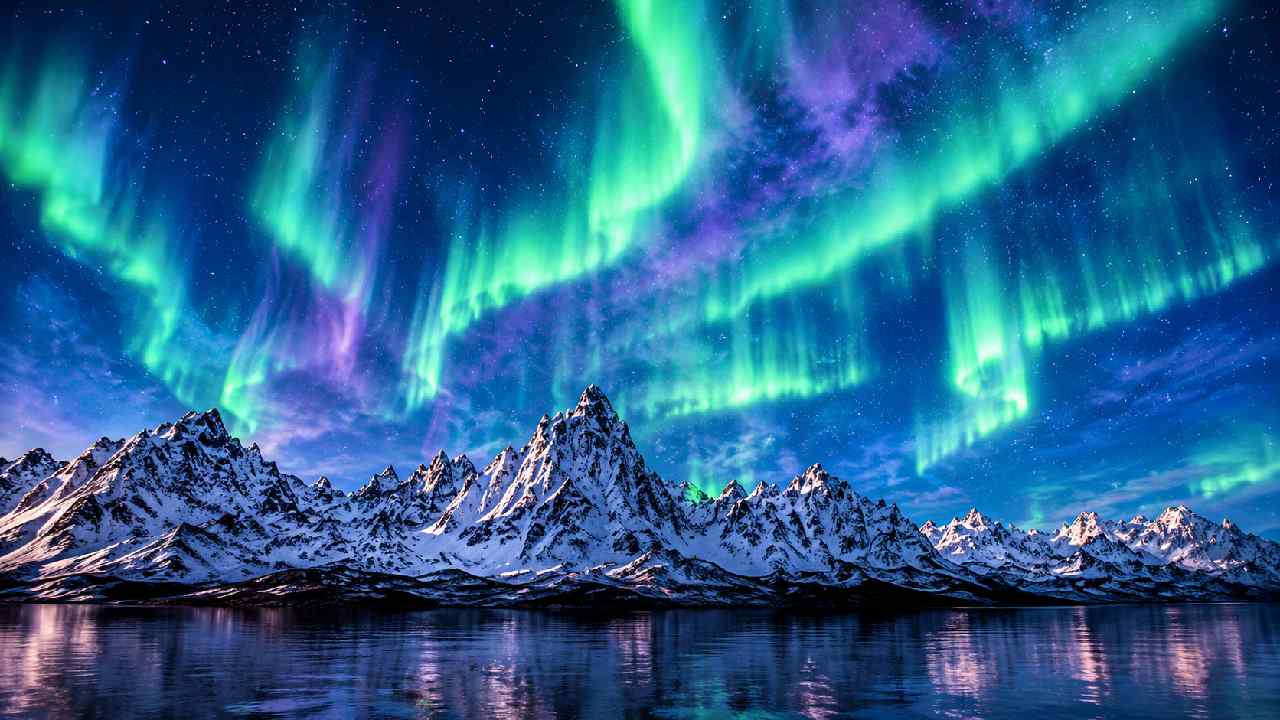
Round Rock Journal – Beauty Aurora is one of the most breathtaking natural phenomena visible from Earth, captivating millions of people every year. Whether shimmering in vibrant green, glowing purple, or displaying soft shades of red, these colorful lights transform the night sky into an unforgettable spectacle. Although many travelers dream of witnessing Aurora in person, the science behind this phenomenon is equally fascinating. Aurora occurs when charged particles from the Sun interact with Earth’s magnetic field and upper atmosphere, creating brilliant curtains of light above the polar regions. As scientific research continues to expand, Aurora has become far more than a tourist attraction. Instead, it serves as an important reminder of the invisible connection between our planet and the dynamic activity occurring millions of kilometers away on the Sun.
Read Also: Military Bus and Civilian Bus Collision in Syria Leaves 35 Dead
The Difference Between the Northern and Southern Lights
Many people recognize Aurora through the famous Northern Lights, yet the same phenomenon also appears in the Southern Hemisphere. The Aurora visible near the Arctic Circle is known as Aurora Borealis, while its southern counterpart is called Aurora Australis. Although both displays are produced by identical physical processes, they occur near opposite magnetic poles of the Earth. Countries such as Norway, Finland, Sweden, Iceland, Canada, and Alaska are among the best destinations for viewing Aurora Borealis. Meanwhile, Aurora Australis can be observed from Antarctica, southern New Zealand, Tasmania, and remote areas of southern Australia. Therefore, regardless of the hemisphere, both forms of Aurora provide equally spectacular natural light displays for fortunate observers.
How the Sun Creates the Aurora
The story of Aurora begins on the surface of the Sun. Every second, the Sun continuously releases streams of electrically charged particles known as the solar wind. During periods of increased solar activity, including solar flares and coronal mass ejections, enormous quantities of these particles travel through space toward Earth. Fortunately, Earth’s magnetic field acts as a powerful protective shield by deflecting most of them. However, some particles become trapped and are guided toward the magnetic poles. Once they enter the upper atmosphere, they collide with oxygen and nitrogen molecules. These collisions release energy in the form of visible light, producing the colorful Aurora that illuminates polar skies. Consequently, every Aurora display reflects both solar activity and Earth’s natural magnetic protection.
Why Aurora Displays Different Colors
The remarkable colors of Aurora depend on the type of atmospheric gas involved and the altitude where the collisions occur. Oxygen molecules are responsible for the brilliant green color that most people associate with Aurora. At higher altitudes, oxygen can also produce deep red light. Meanwhile, nitrogen creates beautiful shades of blue, violet, and pink, adding even greater visual diversity to the display. Additionally, the intensity of solar activity influences how vivid the colors become during each event. Strong geomagnetic storms often generate brighter and more extensive Aurora displays that stretch across wider portions of the sky. Therefore, every Aurora is unique because no two combinations of atmospheric conditions and solar activity are exactly the same.
The Best Places and Seasons to Experience Aurora
Choosing the right location dramatically increases the chances of seeing Aurora. Areas situated close to the Arctic Circle consistently experience the highest frequency of Northern Lights activity. Tromsø in Norway, Finnish Lapland, Iceland, northern Canada, and Alaska remain among the world’s most popular destinations for Aurora tourism. In the Southern Hemisphere, Tasmania, southern New Zealand, and Antarctica provide excellent viewing opportunities for Aurora Australis. Furthermore, winter offers the ideal season because nights become longer and darker, creating better viewing conditions. Clear skies with minimal light pollution also improve visibility. Although Aurora cannot be guaranteed on any specific night, monitoring space weather forecasts significantly increases the likelihood of witnessing this extraordinary phenomenon.
Read Also: Learning to Let Go of What Was Never Meant to Stay
Aurora Helps Scientists Understand Space Weather
Beyond its visual beauty, Aurora plays an essential role in scientific research. Scientists study Aurora to better understand the relationship between solar activity, Earth’s magnetic field, and the upper atmosphere. This research contributes directly to predicting space weather events that may affect satellites, GPS systems, radio communication, aviation, and electrical power grids. Large solar storms have the potential to disrupt modern technology if they interact strongly with Earth’s magnetosphere. Consequently, observing Aurora provides valuable information about conditions occurring in near-Earth space. As technology becomes increasingly dependent on satellites and global communication networks, understanding Aurora has become more important than ever for protecting critical infrastructure around the world.
Aurora Continues to Inspire Travelers and Photographers
Aurora has become one of the world’s most desired travel experiences because few natural events compare to its beauty. Professional photographers often spend hours in freezing temperatures waiting for the perfect display, while travelers journey thousands of miles hoping to witness the colorful lights dancing overhead. Modern digital cameras have also made Aurora photography more accessible, encouraging more people to explore polar destinations. In addition, social media has introduced countless viewers to stunning Aurora images captured across the Arctic and Antarctic regions. These breathtaking photographs inspire curiosity about astronomy, Earth science, and space exploration. As a result, Aurora continues to connect scientific discovery with unforgettable personal experiences.
Aurora Reminds Us of the Powerful Connection Between Earth and the Sun
Aurora is far more than a beautiful light show because it demonstrates the remarkable relationship between our planet and the Sun. Every colorful wave moving across the night sky represents invisible streams of solar energy interacting with Earth’s protective magnetic shield. Without this natural defense, life on Earth would face far greater exposure to harmful solar radiation. Therefore, Aurora symbolizes both the beauty and the importance of Earth’s natural systems working together. As scientific technology continues advancing, researchers will gain even deeper insights into the processes that create these magnificent lights. Meanwhile, Aurora will remain one of nature’s greatest spectacles, inspiring future generations to appreciate both the wonders of space and the incredible planet we call home.