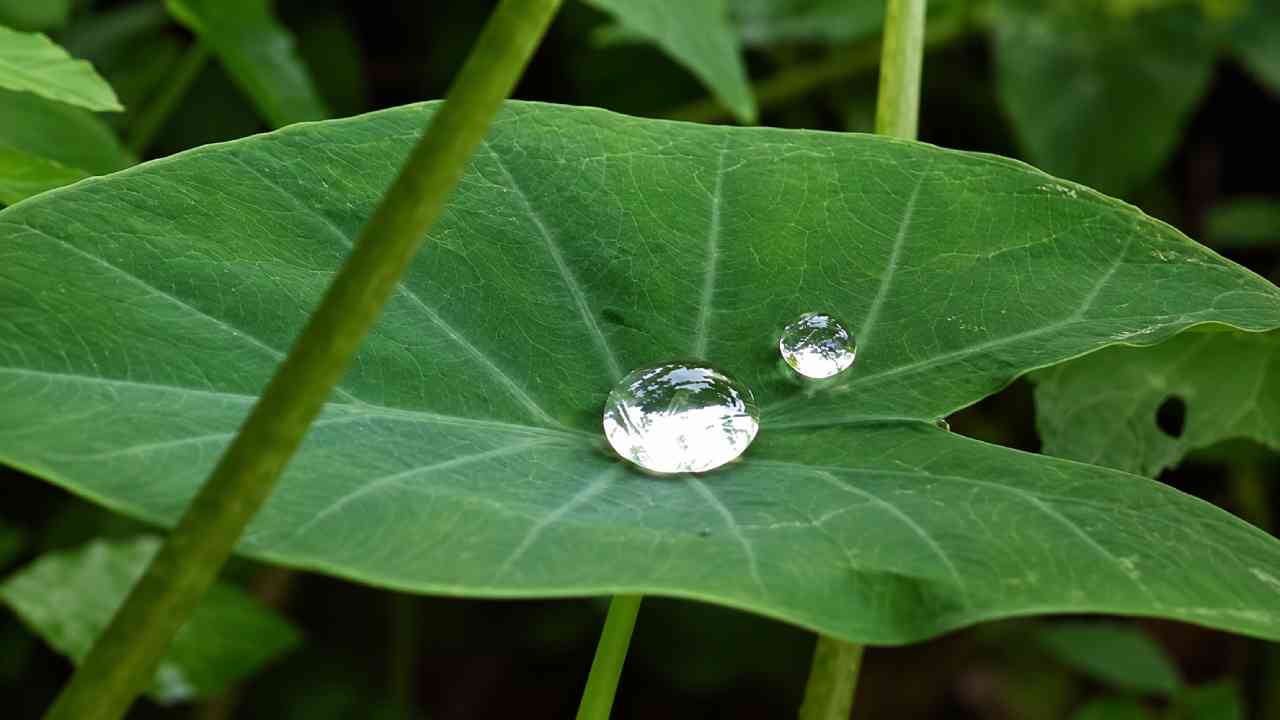
Round Rock Journal – Taro Leaves can make an ordinary rain shower look surprisingly unusual. Instead of spreading across the broad green surface, water often gathers into rounded droplets. These droplets may sit briefly before rolling away when the leaf moves or tilts. At first glance, the effect can look almost artificial. However, the explanation comes from the remarkable structure of the leaf itself. Its surface strongly resists wetting, so water has difficulty spreading into a thin film. Meanwhile, surface tension encourages water molecules to stay together and form compact droplets. Tiny surface structures and waxy materials also reduce how much contact occurs between the water and the leaf. As a result, rain can move across the surface without easily soaking it. This everyday observation offers an accessible introduction to hydrophobicity, surface tension, and plant adaptation. More importantly, it shows how sophisticated natural surfaces can hide behind something as familiar as a garden leaf.
Read Also: Acer Predator Atlas 7 Brings Intel Arc G3 Power to Handheld Gaming
The Leaf Surface Looks Smooth but Hides a Microscopic Landscape
A taro leaf may appear smooth when viewed from a short distance. Under magnification, however, its surface tells a different story. Microscopic structures create a textured landscape that changes how water interacts with the leaf. In addition, waxy compounds cover parts of the surface and strengthen its water-repelling behavior. This combination prevents a droplet from making complete contact with the leaf. Tiny pockets of air can remain beneath parts of the water droplet. Consequently, the contact area becomes smaller than it would be on an ordinary smooth surface. This difference matters because reduced contact makes the water less likely to spread. Instead, the droplet maintains a rounded shape. The effect demonstrates why appearances can be misleading in science. A surface that looks simple to our eyes may contain complex structures at a microscopic scale. Therefore, understanding Taro Leaves requires looking beyond what we can see without magnification.
Surface Tension Helps Water Form Rounded Droplets
The leaf itself provides only part of the explanation. Water also has properties that influence what happens. Water molecules attract one another through intermolecular forces. At the surface, this attraction produces a phenomenon called surface tension. Consequently, a small amount of water naturally tends to minimize its exposed surface area. A sphere provides an efficient shape for doing that, although gravity can flatten larger droplets. On Taro Leaves, the water-resistant surface prevents droplets from spreading easily. Surface tension can therefore keep them compact and bead-like. By comparison, place water on a highly wettable material and it may spread much farther. The difference comes from the balance between cohesion within the water and adhesion between water and the material beneath it. In simple terms, the water holds onto itself more effectively when the leaf offers relatively little attraction. That balance creates the familiar beads that make wet taro leaves so visually striking.
A Waxy Layer Strengthens the Leaf’s Water-Repelling Ability
Plants commonly have a protective outer layer known as the cuticle, which contains waxy materials. This layer helps limit uncontrolled water loss and creates a barrier between plant tissue and the surrounding environment. On highly water-repellent leaves, surface chemistry works together with microscopic texture. Therefore, water does not behave as it would on glass, paper, or untreated fabric. A droplet can remain elevated over much of the surface rather than spreading completely. This effect becomes especially noticeable after rain or watering. Moreover, the wax should not be viewed as a decorative coating. It forms part of a functional plant surface that interacts continuously with moisture, sunlight, particles, and microorganisms. In my view, this is what makes the phenomenon so interesting for light education. Something that looks like a simple water trick actually reveals how physical structure and chemistry can work together. Nature achieves the effect without motors, electricity, or complex mechanical systems.
Water Can Roll Away Because the Droplets Have Less Surface Contact
Once a droplet forms, gravity and leaf movement can help it travel across the surface. Since the droplet has relatively limited contact with the leaf, it can move more easily than water spread across a highly wettable material. Tilt the leaf slightly, and gravity begins pulling the droplet downward. Meanwhile, its compact shape helps it roll or slide instead of remaining firmly attached. Several droplets may even merge along the way. The larger droplet can then move faster as its weight increases. However, not every droplet behaves exactly the same way. Leaf age, surface condition, dust, damage, droplet size, and angle can influence the result. Therefore, describing the leaf as simply “waterproof” misses some of the science. The better explanation involves the interaction between surface structure, chemistry, water properties, and movement. Together, these factors create the dramatic rolling effect people notice after rain.
Taro Leaves Share Similarities With the Famous Lotus Effect
The behavior seen on Taro Leaves resembles the better-known lotus effect, named after the highly water-repellent surface of lotus leaves. Both examples show how surface texture and waxy chemistry can encourage water to form beads instead of spreading freely. Nevertheless, different plant species do not necessarily have identical microscopic structures or exactly the same wetting behavior. That distinction matters when explaining biomimicry accurately. The useful lesson lies in the shared principle: combining suitable surface chemistry with tiny physical structures can greatly reduce wetting. Furthermore, moving droplets may collect some loose particles as they travel across certain water-repellent plant surfaces. This behavior has helped inspire research into self-cleaning materials. Scientists and engineers study natural surfaces because evolution has already produced effective solutions to many environmental challenges. Thus, an observation made in a garden can connect directly with research in materials science and engineering.
Rain Repellency Can Help Leaves Manage Their Surface Environment
Water repellency may provide several practical advantages to plant surfaces. Rapid water removal can reduce the amount of time that moisture remains on a leaf. In addition, rolling droplets can sometimes move loose dust or particles. A drier surface can also change the conditions experienced by microorganisms that depend on persistent moisture. However, plant biology rarely has one simple explanation for every feature. The same surface characteristic may provide several advantages rather than serving a single purpose. Environmental conditions also matter. Tropical plants regularly experience rainfall, humidity, strong sunlight, and biological activity. Therefore, the outer surface of a leaf acts as an important interface between the plant and its surroundings. Taro Leaves offer a particularly visible example because their large surfaces make water behavior easy to observe. This visibility turns an ordinary plant into a useful tool for explaining broader concepts in biology, chemistry, and physics.
Read Also: Doing Everything Alone Is Not Always True Independence
The Same Principle Has Inspired Modern Material Research
Natural water-repellent surfaces have attracted attention far beyond botany. Researchers study them as models for biomimetic materials, which borrow useful ideas from biological systems. For instance, engineers can create microscopic surface textures and adjust surface chemistry to reduce how easily water sticks to manufactured materials. Potential applications include self-cleaning coatings, water-resistant surfaces, textiles, and specialized industrial materials. However, copying nature successfully requires more than making a surface rough. Researchers must consider durability, manufacturing methods, environmental impact, and how the material performs after repeated use. That complexity makes natural leaves even more impressive. Their functional surfaces develop biologically and can operate under changing outdoor conditions. Moreover, the connection between plants and material science provides a valuable educational lesson. Innovation does not always begin with a completely new idea. Sometimes, it begins by closely observing how living organisms already solve familiar problems.
A Simple Home Observation Can Reveal the Effect Clearly
You do not need laboratory equipment to notice the basic behavior of Taro Leaves. A fresh leaf and a few drops of clean water can reveal much of the effect. Place a small droplet on the surface and observe its shape without rubbing or damaging the leaf. Next, gently change the angle of the leaf. The droplet may begin moving while remaining relatively compact. Then, compare the result with water placed on paper, glass, or another common surface. The contrast makes the idea of wettability much easier to understand. However, this simple observation cannot reveal every microscopic detail. Scientists use tools such as microscopes and contact-angle measurements for deeper analysis. Even so, the basic experiment encourages an important scientific habit: observe first, compare carefully, and then ask why. That process turns an everyday encounter with a plant into a small investigation of surface science.
Taro Leaves Show How Complex Science Can Hide in Everyday Nature
The next time rain falls on Taro Leaves, those rolling droplets may look less mysterious, but they should seem no less remarkable. Their behavior emerges from several factors working together. Microscopic texture limits direct contact, waxy surface chemistry discourages wetting, and surface tension keeps water relatively compact. Meanwhile, gravity helps droplets move once the leaf reaches a suitable angle. No single element explains the entire effect on its own. Instead, the phenomenon comes from an interaction between the plant and the physical properties of water. That is precisely why this topic works so well as light education. It begins with a simple question that almost anyone can observe. Yet the answer opens a path toward plant biology, physics, chemistry, and even modern materials engineering. Ultimately, Taro Leaves remind us that some of the most interesting science does not hide inside a laboratory. Sometimes, it sits quietly in the garden after the rain.